
← Back to Blog
Local Living
What Is It Actually Like to Live in Mountain Home Arkansas Day to Day
By Heather Hendricks
ERA Doty Real Estate
October 2, 2026 · 10 min read
What is it actually like to live in Mountain Home Arkansas day to day? People who have relocated here often say the reality surprised them, in ways both practical and unexpected. This article covers the honest, ground-level details: what you pay for groceries, how long it takes to get across town, what the housing stock looks like, where people go on weekends, and what you will not find that you might have taken for granted in a larger city.
1. Getting Around Mountain Home Day to Day
Getting around Mountain Home is straightforward and quick by most standards. The city itself covers roughly 14 square miles, and driving from one side to the other rarely takes more than ten to fifteen minutes, even during the busiest parts of the day.
How Long Does It Take to Get Anywhere?
Most daily errands happen within a five-mile radius. Walmart Supercenter on Highway 62 East is the primary grocery and general merchandise anchor for the area. The Baxter Regional Medical Center campus sits near the center of town. The Mountain Home School District offices, the local library, and most of the retail corridor along Highway 62 are all within a short drive of one another.
If you live in town, you will rarely sit at a stoplight for more than a couple of cycles. The longest waits tend to happen on Highway 62 near the Walmart and Lowe's intersection during the late afternoon. That is the closest thing Mountain Home has to a rush hour.
Roads, Traffic, and Driving Conditions
The Ozark terrain shapes how roads work here. If you live on a rural parcel outside of town, expect winding two-lane county roads with elevation changes. Some lakefront properties sit at the end of gravel roads. In winter, those roads can become slick after ice storms, which do occur in Baxter County. Mountain Home proper stays fairly manageable, but rural residents benefit from a four-wheel-drive or all-wheel-drive vehicle.
If you need to travel to Fayetteville or Little Rock for work or appointments, those trips run roughly two and a half hours to Fayetteville and about two hours to Little Rock, both on two-lane and four-lane state highways. There is no interstate access from Mountain Home, which is a real consideration for anyone whose job requires frequent long-distance driving. For a deeper look at those commute times, see the article on how far Mountain Home is from Fayetteville and Little Rock.
2. Groceries, Shopping, and Everyday Errands
Mountain Home handles most day-to-day shopping needs without requiring a long drive. The retail base is more complete than many towns of its size, roughly 12,000 residents in the city proper with about 42,000 in Baxter County overall.
What You Can Buy Locally
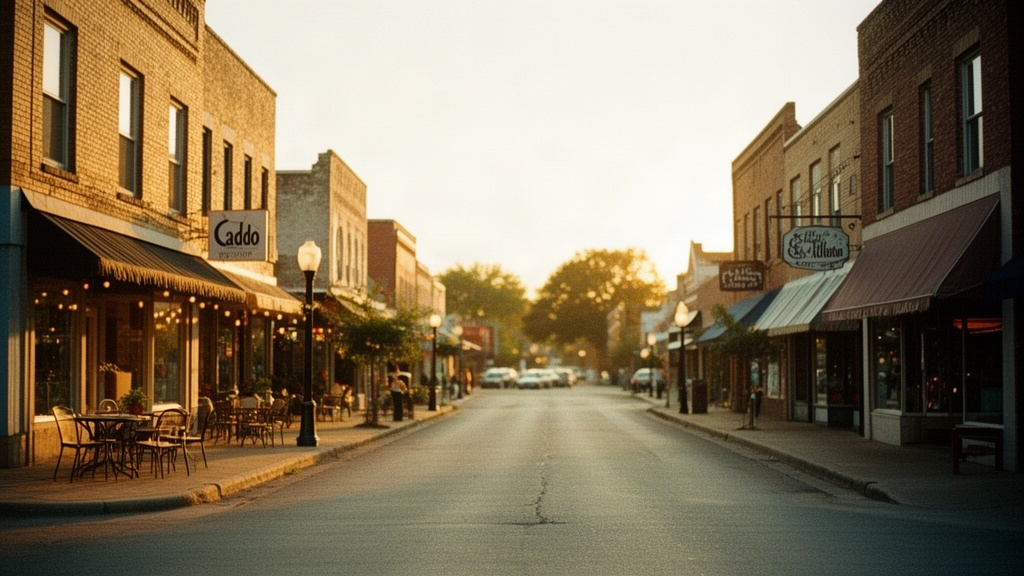
The Walmart Supercenter covers groceries, pharmacy, hardware, and general merchandise. There is also a Harps Food Store, which is a regional Arkansas grocery chain with a full meat counter and produce section. Lowe's handles most home improvement needs. For clothing, there is a Bealls and several smaller local shops downtown on Main Street. The Mountain Home downtown square has seen renewed activity, with local restaurants, a bakery, and specialty shops filling in around the historic courthouse.
Dining options in Mountain Home include several locally owned restaurants alongside national chains. Colton's Steak House, Gaston's White River Resort restaurant, and a handful of Mexican and Chinese restaurants round out the sit-down options. There are also multiple fast food and quick-service spots along the Highway 62 corridor.
What Requires a Longer Trip
Some categories of retail simply do not exist in Mountain Home. There is no mall, no Apple Store, no large electronics retailer, and no Costco or Sam's Club. Residents who want those options typically drive to Batesville, about an hour south, or make a larger trip to Fayetteville or Little Rock a few times a year. Online shopping with delivery fills in a lot of those gaps, and most residents plan for it.
Auto parts, farm supply, and sporting goods are well-represented locally. There is a Tractor Supply, an O'Reilly Auto Parts, and several locally owned sporting goods and outdoor equipment shops that cater to the fishing and hunting community. If outdoor gear is part of your regular spending, Mountain Home is unusually well-stocked for a city its size.
3. Healthcare and Medical Services
Healthcare is one of the most important practical questions for anyone relocating to a smaller city, and Mountain Home holds up well compared to other rural Arkansas communities of similar size.
What Is Available in Baxter County
Baxter Regional Medical Center is the cornerstone of local healthcare. It is a full-service, 268-bed hospital located in Mountain Home that provides emergency care, surgery, cardiology, oncology, orthopedics, and a range of outpatient services. The hospital employs over 1,400 people and is one of the largest employers in the county. Primary care physicians, internists, and several specialist practices are affiliated with the hospital and operate clinics in town.
There are also multiple pharmacy locations, including a hospital pharmacy, two Walgreens locations, and independent pharmacies. Dental and vision care are available locally through several private practices. Mental health services exist through Ozark Guidance and other providers, though availability of certain counseling specialties can be limited.
Specialty Care and When You Travel
Some subspecialties require travel. Complex neurosurgery, advanced pediatric care, and certain cancer treatment protocols typically send patients to Little Rock or Springfield, Missouri, which is about two hours north. Residents with ongoing specialty needs factor in those drives when deciding where to settle within the region. For routine care and most acute situations, staying local is entirely workable.
4. Housing Stock and What You Actually Get for Your Money
Housing in Mountain Home and Baxter County is one of the most compelling parts of the relocation conversation. The variety is wide, and the price-per-square-foot remains well below what buyers find in Northwest Arkansas or most metro markets.
Price Ranges and Property Types
As of September 2026, median home prices in Mountain Home sit in the mid-to-upper $200,000s for a standard in-town property. Entry-level homes, typically older ranch-style houses from the 1970s and 1980s on quarter-acre to half-acre lots, start in the $150,000 to $185,000 range. Move-up homes with updated kitchens, three or four bedrooms, and larger lots run from the upper $200,000s through the $350,000 range. New construction in subdivisions on the north and east sides of town is active, with builders pricing finished homes from the low $300,000s upward depending on finishes and lot size.
The housing stock in Mountain Home is a mix of mid-century brick ranches, 1990s and 2000s vinyl-sided construction, and newer builds. Downtown has some older craftsman and Victorian-era homes. The surrounding county has acreage properties, hobby farms, and rural parcels ranging from two acres to several hundred, often priced by the land as much as the structure.
Lakefront and Rural Properties
Lakefront properties on Bull Shoals Lake and Norfork Lake carry a meaningful premium. Homes with direct water access and a dock typically start in the $400,000s and run well past $1 million for larger or recently renovated properties. Waterfront cabins and older lake houses on smaller coves can still be found in the $300,000 range, though those move quickly. The lake property market in Baxter County is its own distinct segment with its own dynamics, and buyers interested in it benefit from working with someone who knows those coves and access points personally.
If you are relocating and trying to understand what your budget buys here compared to where you are coming from, the article on buying a home in Mountain Home as a relocating buyer walks through the full process, costs, and timeline in detail.
5. Outdoor Life, Recreation, and What People Do Here
The outdoor recreation available around Mountain Home is genuinely one of its defining characteristics. This is not a place where people commute out of town for nature; it surrounds the community on all sides.
Bull Shoals Lake and Norfork Lake
Bull Shoals Lake has over 1,000 miles of shoreline and sits about fifteen minutes from downtown Mountain Home. Norfork Lake, another Army Corps of Engineers reservoir, is roughly the same distance to the southeast. Both lakes support boating, fishing, swimming, and camping. Bass fishing on both lakes draws anglers from across the country, and the White River below Bull Shoals Dam is nationally recognized for trout fishing. Gaston's White River Resort, located just outside Mountain Home near Lakeview, has operated as a fishing destination since 1958.
Multiple public boat launches, marinas, and campgrounds operate on both lakes. Bull Shoals State Park and Norfork Lake State Park provide maintained access points, picnic areas, and overnight facilities. Residents who boat or fish regularly often describe the proximity to the water as the single biggest factor in their decision to stay.
Trails, Parks, and Town Amenities
In town, Mountain Home has a paved trail system connecting several parks. Roller Citizens Park is the main municipal park, with sports fields, a splash pad, a walking track, and picnic pavilions. The Twin Lakes Playhouse is the local community theater and has been staging productions for decades. The Baxter County Library on Baker Street is a well-maintained facility with regular programming. The Twin Lakes Shooting Sports Complex draws competitive shooters from across the region.
For people who want to stay active, the Ozark terrain around the city supports hiking and mountain biking on both developed and informal trails. The Buffalo National River is about forty-five minutes west, offering float trips, hiking, and wilderness camping. Residents who enjoy outdoor activities rarely feel like they have run out of options.
You can read more about what residents and visitors say about daily life in Mountain Home through resources like Livability.com's Mountain Home profile, which aggregates data on amenities, healthcare access, and quality-of-life indicators.
6. The Pace of Life and What Takes Adjustment
Understanding what day-to-day life in Mountain Home Arkansas is actually like means being honest about the adjustments that come with smaller-city living. Most people who relocate here from larger markets go through a short recalibration period.
What Mountain Home Does Not Have
There is no commercial airport with scheduled service in Mountain Home. The Baxter County Regional Airport handles private and charter flights. The nearest commercial airports are in Fayetteville (XNA), about two and a half hours, and Little Rock (LIT), about two hours. Residents who travel frequently for work plan their schedules around those drives or keep a vehicle at one of those airports.
Entertainment options are more limited than in a metro area. There is no movie theater currently operating in Mountain Home as of September 2026, though the community has discussed bringing one back. Concerts and large events typically require a drive. The Twin Lakes Playhouse and occasional touring acts at local venues fill in some of that gap, but residents who attend live music or theater frequently tend to plan day trips.
Higher education options locally are limited to Arkansas State University Mountain Home, a two-year campus that offers associate degrees and some workforce training programs. Students pursuing four-year degrees typically attend online programs or commute to larger campuses.
What Makes It Work Anyway
The cost of living in Mountain Home is measurably lower than in most comparable markets. Property taxes in Baxter County are among the lower rates in Arkansas. Arkansas does not tax Social Security income and has relatively modest income tax rates, which matters for retirees and remote workers alike. Utility costs are moderate. The combination of lower housing prices and lower ongoing costs means that a dollar stretches further here than in most places people are relocating from.
The pace of daily life is genuinely slower in the sense that transactions happen with less friction. Parking is free and available everywhere. Wait times at local businesses are short. Neighbors tend to know one another. The community supports a number of civic organizations, churches, and volunteer groups that give people ways to get involved quickly after moving in.
Remote workers have increasingly discovered Mountain Home over the past few years. Broadband internet service is available in most parts of the city through providers including Cox and local fiber options, which makes working from home viable. The combination of affordable housing and outdoor access has drawn people from tech hubs, coastal cities, and large Midwestern metros who want a lower overhead and a different daily rhythm.
For people considering a move and wanting to understand the full picture of the local real estate market alongside the lifestyle, the Mountain Home Arkansas real estate market guide covers pricing, neighborhood characteristics, and current market timing in depth.
FAQ
Is Mountain Home Arkansas a good place to live if you work remotely?
Mountain Home works well for remote workers in practical terms. Broadband internet through Cox and local fiber providers is available throughout most of the city, and housing costs are substantially lower than in most markets where remote workers tend to concentrate. The tradeoff is the absence of a commercial airport, which means frequent business travel requires a two-to-two-and-a-half-hour drive to Fayetteville or Little Rock. For people whose work is fully remote and whose travel is occasional, the cost savings and outdoor access tend to outweigh that inconvenience. Many people who relocated here in the past few years cite remote work as the reason the move became possible at all.
What do people do for fun in Mountain Home Arkansas on a typical weekend?
On a typical weekend, residents of Mountain Home tend to spend time on or near the water. Bull Shoals Lake and Norfork Lake are both within fifteen to twenty minutes of town and support boating, fishing, swimming, and lakeside gatherings. The White River below Bull Shoals Dam draws trout fishers year-round. In town, Roller Citizens Park hosts youth sports leagues, and the Twin Lakes Playhouse runs productions through much of the year. Day trips to the Buffalo National River about forty-five minutes west are common for hiking and floating. Residents who want urban entertainment typically plan occasional trips to Fayetteville or Little Rock rather than expecting that kind of activity locally.
How does the cost of living in Mountain Home Arkansas compare to larger Arkansas cities?
Mountain Home's cost of living runs noticeably lower than Fayetteville, Bentonville, or Little Rock across most categories. Housing is the most significant difference: median home prices in Mountain Home sit in the mid-to-upper $200,000s as of September 2026, while comparable homes in Fayetteville or the Bentonville area often run $100,000 to $200,000 more. Property taxes in Baxter County are on the lower end of the Arkansas scale. Groceries and utilities are close to state averages. The main areas where Mountain Home costs more, indirectly, are transportation and access: residents drive farther for specialty shopping, medical subspecialties, and air travel, so fuel and vehicle costs can be higher than in a city where those services are nearby.