← Back to Blog
Market Trends
Muscatine, Iowa Real Estate Market Guide: What Locals Actually Tell Their Clients About Prices, Neighborhoods and Timing
By Jessie Krieger
September 27, 2026 · 12 min read
When people in Muscatine, Iowa refer their own clients to a real estate market guide, they want one that skips the filler and gets straight to what actually moves the needle: current prices, how specific neighborhoods differ, and when to act. This guide covers exactly that, drawing on local market data and the kind of on-the-ground detail that only comes from working this market every week.
1. What the Muscatine Housing Market Looks Like Right Now
Muscatine's housing market in September 2026 is active but measured. Inventory has ticked up slightly compared to the tight conditions of 2024 and 2025, giving buyers a bit more breathing room without tipping into a full buyer's market. Homes that are priced correctly and show well are still moving in under three weeks in most price bands.
Median Prices and Inventory Levels
The median sale price for a single-family home in Muscatine County is sitting in the low-to-mid $180,000s as of September 2026, up from roughly $165,000 two years ago. That appreciation has been steady rather than explosive, which is actually a healthy sign for a city of Muscatine's size. The $140,000 to $220,000 range accounts for the largest share of closed transactions, with a meaningful cluster of listings also appearing between $220,000 and $300,000 as updated colonials and newer ranch builds on the west side come to market.
Active listing counts in Muscatine County have hovered between 90 and 130 homes in recent months, which translates to roughly 2.5 to 3.5 months of supply. That figure sits between the sub-two-month inventory of a hot seller's market and the five-plus months that would signal a buyer's advantage. For context on how those numbers fit into the statewide picture, the Muscatine, IA Housing Market Analysis published by the City of Muscatine provides a useful baseline for understanding local supply and demand dynamics.
How Muscatine Compares to the Broader Iowa Market
Statewide, Iowa's median home price has climbed into the low $230,000s in 2026, which means Muscatine still offers a meaningful price advantage over many larger Iowa metros. Des Moines and Iowa City have both seen sharper price escalation, and buyers priced out of those markets have increasingly looked east toward the Quad Cities corridor, with Muscatine sitting squarely along that route on US-61. The city's position on the Mississippi River, its manufacturing base anchored by employers like HNI Corporation and Grain Processing Corporation, and its relative affordability make it a market worth watching closely.
For buyers comparing Muscatine to nearby Davenport or Bettendorf, the commute factor matters. The drive from Muscatine to downtown Davenport runs about 30 to 35 minutes on US-61 under normal conditions, which many buyers find workable. You can read a full breakdown of that commute in the Muscatine to Davenport commute guide published here.
2. A Neighborhood-by-Neighborhood Look at Muscatine
Muscatine's neighborhoods each carry a distinct character shaped by their geography, housing era, and proximity to the river or commercial corridors. Understanding what physically distinguishes one area from another helps buyers focus their search and helps sellers price with confidence. No area is objectively better than another; each offers a different set of trade-offs that depend entirely on what a buyer needs from their home and daily routine.
The Riverfront District and Downtown Core
The blocks closest to the Mississippi waterfront include a mix of older Victorian-era homes, converted multi-unit buildings, and smaller craftsman bungalows, many of them built between the 1880s and 1930s. Lot sizes here tend to be narrow and deep, a remnant of the original plat layout. Riverview Park runs along the water and gives this part of town a genuine green edge. Prices in the riverfront corridor vary considerably based on condition and renovation history; a fully updated Victorian can list anywhere from $180,000 to $280,000, while an unrenovated property on the same block might open at $90,000 to $120,000.
The downtown core itself has seen renewed commercial activity along Iowa Avenue and 2nd Street, with locally owned restaurants, the Muscatine Art Center, and the Pearl City Station development adding foot traffic. For buyers interested in walkability to amenities and river views, this corridor deserves a close look. For more detail on what the riverfront real estate market looks like specifically, the Muscatine riverfront area guide covers that territory in depth.
West Hill and the Historic Bluff Area
West Hill sits above the downtown core on the bluff that gives Muscatine its distinctive topography. Homes here are predominantly two-story frame houses and four-squares built in the early twentieth century, with larger lots than the riverfront blocks and mature tree canopy that shades the streets in summer. The Weed Park area, with its 100-plus acres of trails, a swimming pool, and picnic grounds, anchors the recreational side of this part of the city. Prices in the West Hill and bluff area generally run from the mid-$130,000s for homes needing cosmetic work up to the low $300,000s for fully updated properties with river views.
Suburban Corridors: Mulberry and Beyond
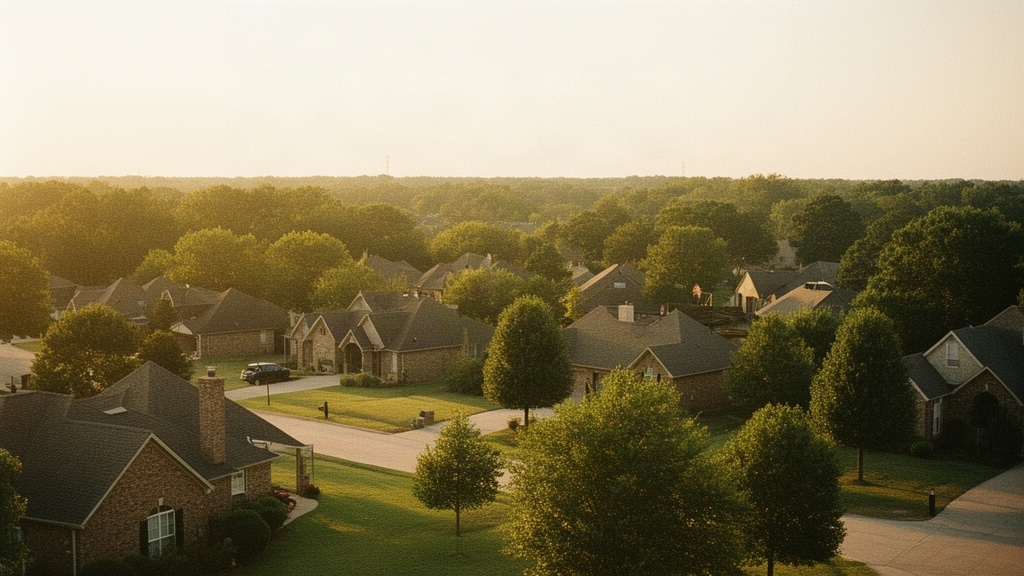
Moving west along Mulberry Avenue and into the subdivisions that have developed since the 1970s, the housing stock shifts to ranch homes, split-levels, and newer two-story builds on larger lots. This corridor includes some of the city's newer construction, with subdivisions that have added homes in the $220,000 to $350,000 range over the past decade. Attached garages, open floor plans, and newer mechanical systems are standard in this zone. The trade-off is distance from downtown: most addresses here sit 10 to 20 minutes from the riverfront by car.
The Sunset Hills area, which sits within this broader western corridor, has its own distinct character worth researching. If you want a detailed breakdown of what Sunset Hills offers in terms of housing stock and price points, the Sunset Hills neighborhood guide covers it specifically.
North End and Industrial Corridor Pockets
The north end of Muscatine, running toward the industrial plants along the river, contains some of the city's most affordable housing. Bungalows and smaller frame homes from the mid-twentieth century dominate this area, with prices frequently in the $80,000 to $150,000 range. These properties attract investors, first-time buyers working with tight budgets, and buyers who prioritize square footage per dollar over finishes. Proximity to the HNI campus and the port facilities means some blocks experience light industrial noise and truck traffic, which is worth factoring into a walkthrough.
3. Timing the Muscatine Market: When to Buy and When to Sell
Timing in Muscatine follows Iowa's broader seasonal rhythm, but with some local wrinkles worth understanding. The spring listing surge that dominates national real estate coverage applies here too, but Muscatine's market also sees meaningful activity in late summer and early fall as buyers who missed spring inventory circle back.
Seasonal Patterns in Muscatine Listings
New listings in Muscatine County typically peak between late March and mid-June, which is when sellers who have been waiting through winter finally pull the trigger. July and August tend to see a modest dip in new inventory as summer schedules disrupt the listing process, but buyer demand often stays steady, which compresses days-on-market for the homes that do come up. September, right now, is historically one of the better windows for buyers: some spring listings that did not sell have had price reductions, and competition from other buyers has thinned compared to April and May.
November through January is the slowest stretch for new listings, but that can actually work in a buyer's favor. Sellers listing in winter often have a genuine motivation, whether a job relocation, an estate situation, or a timeline that cannot wait for spring. Buyers willing to look in December and January frequently face less competition and encounter sellers more open to negotiation on price or terms.
What Buyers Should Watch For Right Now
In September 2026, buyers in Muscatine are navigating a market where mortgage rates remain elevated compared to the historic lows of 2020 and 2021, which has cooled some of the frenzy but has not erased competition in the under-$200,000 price band. Homes priced between $140,000 and $190,000 in move-in condition still attract multiple offers within the first week of listing. Above $250,000, the market is noticeably more deliberate: buyers take more time, request inspections with fewer waivers, and negotiate on price more readily.
Getting pre-approved before you tour homes is not optional in this market; it is the minimum baseline. Sellers in Muscatine routinely ask to see a pre-approval letter before scheduling a showing on a well-priced listing. Understanding the full cost of a purchase, including closing costs, is equally important. The closing costs guide for Muscatine buyers breaks down exactly what to expect at the table.
What Sellers Should Know Before Listing
Sellers in Muscatine who price accurately from day one consistently outperform those who start high and reduce. A home that sits for more than 30 days in this market starts to collect a stigma in buyers' minds, even if the underlying property is solid. The first 10 to 14 days on market are when a listing gets its maximum organic attention, so pricing right at the outset is the single most important decision a seller makes.
Preparation also matters more than sellers often expect. In Muscatine's older housing stock, pre-listing inspections can surface issues with knob-and-tube wiring, aging furnaces, or foundation pointing that, if disclosed proactively, can actually strengthen buyer confidence rather than derail a deal. For a detailed look at how pricing and timelines work from the seller's side, the Muscatine seller's guide to pricing and timeline covers the process step by step.
4. The Numbers Behind Muscatine Real Estate: What to Budget
Knowing the median price is only a starting point. Buyers and sellers both benefit from understanding how prices break down by property type and what carrying costs look like in Muscatine specifically, since Iowa's property tax structure and utility costs differ from national averages in ways that affect monthly budgets.
Purchase Price Ranges by Property Type
Entry-level single-family homes in Muscatine, typically two to three bedrooms with one bath and a detached garage, start around $80,000 to $120,000 in areas like the north end and older east-side blocks. Mid-range homes, which make up the bulk of the market, fall between $140,000 and $240,000 and include updated three-bedroom ranches and four-bedroom two-stories in the western subdivisions. The upper segment of the Muscatine market, homes priced above $300,000, tends to feature newer construction, larger lots, finished basements, and in some cases Mississippi River views from the bluff. Condominiums and townhomes represent a smaller slice of the market but have seen increased interest from buyers looking to reduce exterior maintenance.
Long-term appreciation data for Muscatine is available through NeighborhoodScout's Muscatine real estate market analysis, which tracks historical price trends and can help buyers understand how the city's values have moved over five and ten year periods.
Carrying Costs and Closing Expectations
Iowa's property taxes are set at the county level and assessed on a rollback formula that can be confusing for buyers relocating from other states. In Muscatine County, effective property tax rates for residential properties have generally run between 1.3% and 1.8% of assessed value, though the rollback means the taxable value is lower than the assessed value. A home purchased at $185,000 might carry annual taxes in the $2,200 to $3,000 range depending on its classification and any applicable exemptions. Homestead credits can reduce that figure for primary residents, so filing for that exemption promptly after closing is worth doing.
Heating costs in Muscatine's older housing stock can run higher than buyers expect, particularly in homes with original windows and minimal attic insulation. A home energy audit before purchase, or at minimum a careful review of the seller's utility history, is a practical step that can surface meaningful budget information. Natural gas is the dominant heating fuel in Muscatine, and MidAmerican Energy serves most of the city.
5. What Experienced Muscatine Buyers and Sellers Wish They Had Known
The details that trip up buyers and sellers in Muscatine are rarely the ones covered in national real estate articles. They tend to be local specifics: how the city's topography affects flood zone designations, how Iowa's disclosure laws work in practice, and what negotiating norms look like in a market of this size.
Common Misconceptions About the Local Market
One of the most common misconceptions buyers bring to Muscatine is that a lower list price automatically means a lower-cost home. A $110,000 home with a failing furnace, outdated electrical panel, and a foundation in need of tuckpointing can easily require $40,000 to $60,000 in repairs before it is genuinely livable. Conversely, a $195,000 home with updated mechanicals, a newer roof, and a finished basement can represent significantly better value per dollar. Comparing homes on list price alone without factoring in condition and deferred maintenance is one of the fastest ways to end up with a disappointing purchase.
Another common misconception is that Muscatine's market moves slowly because it is a smaller city. Well-priced homes in the $140,000 to $200,000 range routinely go under contract within 7 to 14 days in the current market. Buyers who assume they have weeks to deliberate before making an offer frequently lose properties they genuinely wanted. Having your financing in order and being ready to move quickly on a home that checks your boxes is not urgency for its own sake; it is just how this market operates.
Questions Worth Asking Before You Commit
Before writing an offer on any Muscatine property, buyers should ask about the age of the roof, furnace, and water heater; whether the home is in a FEMA-designated flood zone; and what the seller's utility costs have averaged over the past 12 months. Iowa is a disclosure state, meaning sellers are required to disclose known material defects, but disclosure forms only capture what sellers know and choose to report. An independent inspection remains the buyer's most reliable tool for understanding what they are actually purchasing.
Sellers, on the other hand, should ask their agent how comparable sales have been priced per square foot in their specific neighborhood, not just citywide. A three-bedroom ranch on the west side and a three-bedroom ranch on the north end can have very different price-per-square-foot realities even though they are technically the same property type. Understanding Iowa's offer and acceptance process is also worth reviewing before you list; the Iowa offer process guide explains the state-specific steps clearly.
Jessie Krieger works in this market every week and brings exactly this kind of ground-level knowledge to every client conversation. Whether you are buying your first home, selling a property you have owned for years, or relocating to Muscatine from outside Iowa, having a local guide who knows the difference between a west-side ranch and a north-end bungalow at a glance is the kind of advantage that pays off at every stage of the transaction.
FAQ
What is the current median home price in Muscatine, Iowa?
As of September 2026, the median sale price for a single-family home in Muscatine County is in the low-to-mid $180,000s, up from approximately $165,000 two years ago. The most active price band runs from $140,000 to $220,000, which accounts for the largest share of closed transactions. Homes above $250,000 exist in the market but move more slowly and see more negotiation on price and terms. For buyers relocating from higher-cost metros, Muscatine's price points offer meaningful affordability relative to the quality of housing stock available.
Is it a buyer's or seller's market in Muscatine right now?
In September 2026, Muscatine sits in a balanced-to-slight-seller's-market condition, with roughly 2.5 to 3.5 months of housing supply available. That means well-priced homes in the under-$200,000 range still attract multiple offers and move quickly, while the $250,000-and-above segment gives buyers more time and negotiating room. Inventory has loosened somewhat compared to 2024 and 2025, but it has not shifted decisively toward buyers. The practical implication is that buyers need to be prepared and decisive, while sellers still benefit from accurate pricing rather than testing the market high.
When is the best time of year to buy or sell a home in Muscatine?
Sellers in Muscatine typically benefit from listing in the spring window between late March and mid-June, when buyer demand is highest and competing inventory has not yet peaked. Buyers, on the other hand, often find more opportunity in September and October, when some spring listings have been reduced and competition has thinned. The winter months from November through January bring the fewest listings but also the fewest competing buyers, which can create negotiating opportunities for buyers willing to look during that period. The right timing ultimately depends on individual circumstances, financing readiness, and the specific price range a buyer is targeting.