.webp)
Marketing
Long Tail Keywords for Real Estate: How to Attract Qualified Buyers
Long tail keywords for real estate help you reach serious buyers searching for specific properties — not casual browsers clicking through generic listings. This guide covers what long tail keywords are, why they work, and how to find and use them in your marketing.

March 10, 2026

6 min read
Share





What We'll Explore
1. What Are Long Tail Keywords?
2. Why Long Tail Keywords Work for Real Estate
•
Buyers Search With Specificity
•
Competition Is Manageable
•
Quality Over Quantity
3. Finding Long Tail Keywords for Real Estate
•
Start With Property Features
•
Use Search Suggestions
•
Leverage Keyword Tools
•
Study Your Own Inquiries
4. Using Long Tail Keywords Effectively
•
Website Content
•
Blog Content
•
Video Content
•
Property Websites
5. Common Long Tail Keyword Patterns
1. What Are Long Tail Keywords?
Long tail keywords are specific, multi-word phrases that describe exactly what someone is searching for. Unlike broad terms ("homes for sale"), long tail keywords capture detailed intent ("mid-century modern home with pool in Scottsdale").
The name comes from search volume distribution. A few broad keywords get massive search volume (the "head"), while thousands of specific phrases each get smaller volume (the "long tail"). Combined, these specific searches represent the majority of all search activity.
According to Ahrefs research, over 92% of all keywords get ten searches per month or fewer. The opportunity lies in targeting many of these specific phrases rather than competing for a handful of high-volume terms.
For real estate, this matters because:
Specific searches indicate serious intent. Someone searching "3 bedroom home with guest house under $600k in North Phoenix" knows what they want. They're further along in their buying journey than someone searching "Phoenix homes."
Less competition means easier ranking. National portals dominate broad terms. Long tail phrases give local agents a realistic chance to appear in search results.
Higher conversion rates. Visitors who find exactly what they're searching for convert at higher rates than visitors browsing generally.
2. Why Long Tail Keywords Work for Real Estate
Real estate is inherently specific. Buyers don't want "a house" — they want a particular type of home, in a specific location, with certain features, at a price they can afford.
Buyers Search With Specificity
Think about how you'd search if you were buying a home. You might start broad ("homes for sale Miami") but quickly narrow your search:
- "Waterfront condos in Brickell"
- "Single-family homes with pool in Coral Gables"
- "New construction townhomes near Dadeland"
- "Pet-friendly apartments in Coconut Grove"
Each of these phrases represents a long tail keyword — and a buyer with defined criteria actively searching for options.
Competition Is Manageable
Long tail keywords are the smart path for local agents to win visibility in a landscape where national portals compete heavily for broad terms like "Miami real estate."
But "waterfront homes with boat dock in Key Biscayne" has far less competition. An agent who creates content specifically addressing that search has a realistic path to ranking.
Quality Over Quantity
Long tail traffic is smaller in volume but higher in quality. One visitor who searched for exactly what you offer is worth more than ten visitors who stumbled onto your site through a generic search.
This efficiency matters for agents. You're not trying to attract millions of visitors — you're trying to connect with the handful of buyers looking for properties you can help them find.


3. Finding Long Tail Keywords for Real Estate
Identifying the right long tail phrases requires understanding what your target buyers search for.
Start With Property Features
List the features that define properties in your market:
- Architectural styles (mid-century modern, craftsman, Mediterranean)
- Lot characteristics (waterfront, mountain view, corner lot, acreage)
- Home features (pool, guest house, home office, three-car garage)
- Age and condition (new construction, recently renovated, historic)
- Community types (gated community, 55+ community, golf course)
Combine these features with locations to create long tail phrases.
Use Search Suggestions
Google's autocomplete reveals what people search for. Start typing a phrase like "homes for sale in [your city] with..." and note what suggestions appear. These represent common searches.
Google's "People also ask" and "Related searches" sections at the bottom of results pages provide additional keyword ideas.
Leverage Keyword Tools
Tools like Google Keyword Planner, Ubersuggest, or Ahrefs can identify search volume for specific phrases. Look for keywords with:
- Enough search volume to matter (even 10-50 monthly searches can be valuable)
- Clear buying intent
- Relevance to properties you represent
Study Your Own Inquiries
Pay attention to how buyers describe what they're looking for. The language they use in conversations and emails often mirrors their search queries.
If multiple buyers ask for "single-level homes with large backyards in [neighborhood]," that's likely a phrase others are searching for online.


4. Using Long Tail Keywords Effectively
Finding keywords is step one. Implementing them across your content drives results.
Website Content
Create dedicated pages for the specific property types and areas you serve. A page titled "Waterfront Homes in [City]" targeting that long tail phrase can rank for relevant searches.
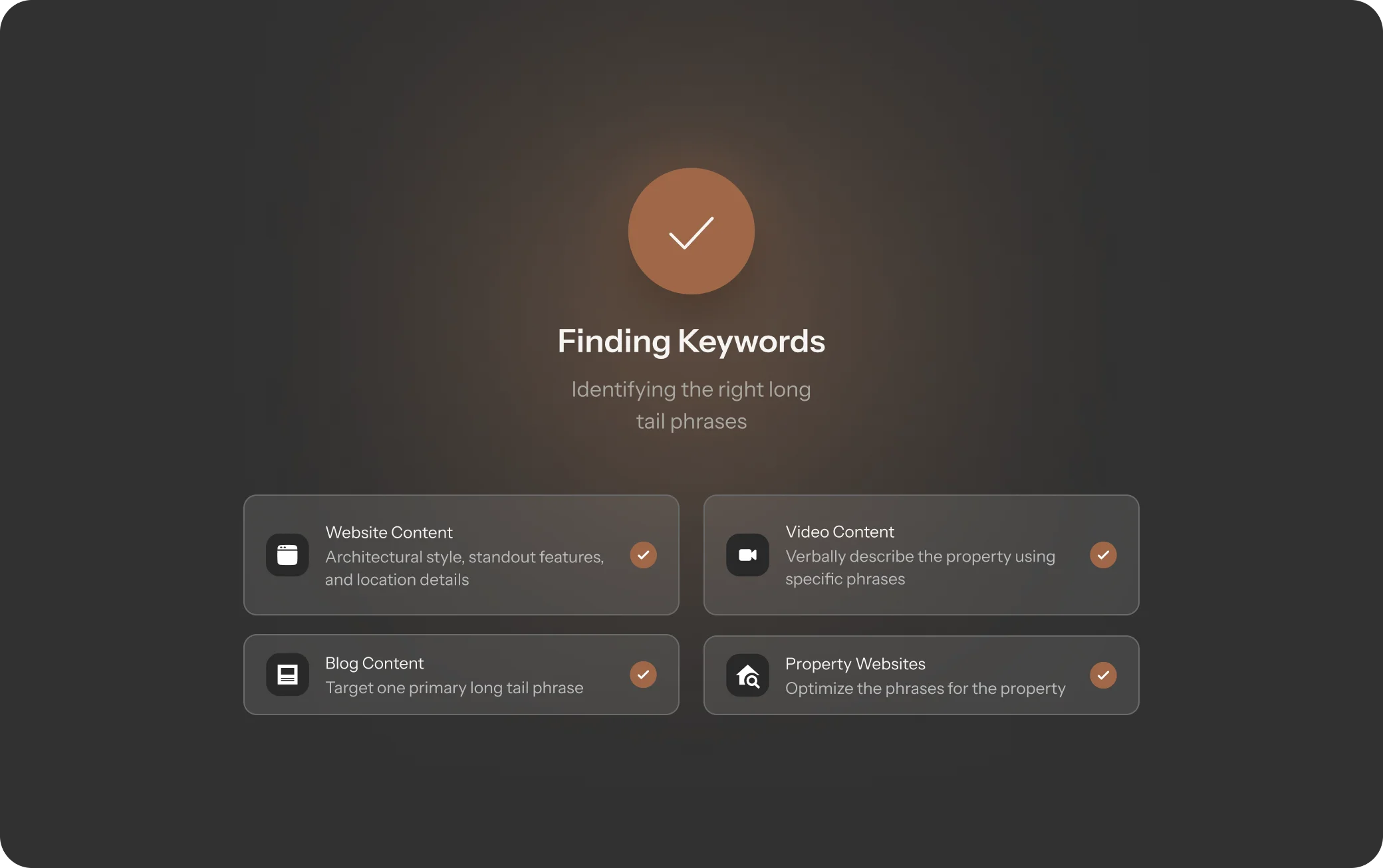
Listing descriptions should incorporate relevant long tail phrases naturally. Describe the architectural style, standout features, and location details using the language buyers search for.
Blog Content
Blog posts allow you to target informational long tail keywords. 'Neighborhoods to explore in [City]' or 'What to know about buying a historic home in [Area]' attract buyers researching before they transact.
Each post should target one primary long tail phrase while naturally incorporating related terms.
Video Content
Long tail keywords work in video just as they do in text. The words spoken in listing videos get indexed by search engines, and YouTube functions as its own search engine.
When recording listing videos, verbally describe the property using specific phrases: "This single-level mid-century modern home features an updated kitchen, saltwater pool, and mountain views." Those phrases become searchable.
Tools like Trolto generate listing videos automatically from your photos. The property descriptions you provide become the foundation for how those videos appear in search — another reason to write listings with specific, searchable language.
Property Websites
Single-property websites dedicated to individual listings provide additional opportunities to target long tail keywords. With full control over the content, you can optimize specifically for the phrases most relevant to that property.
Trolto creates these property websites automatically, giving each listing its own searchable destination beyond the major portals.
5. Common Long Tail Keyword Patterns
These patterns help you generate long tail keywords for your market:
[Property type] in [neighborhood]
- "Condos in downtown Austin"
- "Townhomes in Cherry Creek"
[Property type] with [feature] in [city]
- "Homes with pools in Scottsdale"
- "Houses with guest houses in Los Angeles"
[Adjective] [property type] in [area]
- "Luxury homes in Pacific Palisades"
- "Affordable condos in Capitol Hill"
[Style] homes in [location]
- "Mid-century modern homes in Palm Springs"
- "Craftsman homes in Seattle"
[Community type] in [area]
- "Gated communities in Henderson"
- "55+ communities in Sarasota"
Generate variations by combining different features, locations, and property types relevant to your market.
FAQ
How many long tail keywords should I target?
There's no fixed number — it depends on your content capacity. Each page or blog post should focus on one primary keyword phrase. Over time, you'll build a library of content targeting dozens of specific phrases. Prioritize keywords with clear buyer intent and relevance to properties you can represent.
Do long tail keywords work for luxury real estate?
They work especially well for luxury. High-end buyers have specific requirements and search with precision. Phrases like "oceanfront estate with private beach in Malibu" or "penthouse with city views in Manhattan" reach qualified buyers who know exactly what they want.
How long until I see results from long tail keyword targeting?
SEO results typically take 3-6 months to materialize. Long tail keywords often rank faster than competitive broad terms because there's less competition. Consistency matters — regularly publishing optimized content compounds your visibility over time.
Target the Searches That Matter
Long tail keywords for real estate connect you with buyers searching for exactly what you offer. While individual phrases have lower volume, they collectively represent how serious buyers search — with specificity and intent.
Build content that answers these specific searches: neighborhood pages, property type guides, blog posts addressing buyer questions. Combined with professional listing marketing — including video content and dedicated property websites — you create multiple touchpoints for qualified buyers to find you.
If creating that content feels time-intensive, Trolto can help by generating listing videos, property websites, and daily branded content automatically — keeping your online presence active while you focus on clients.
See how Trolto works