.webp)
Industry
How to Write a Real Estate Agent Resume That Gets Interviews
Your real estate agent resume matters when joining a brokerage, applying to a team, or pursuing opportunities at luxury firms. This guide covers what to include, how to present your experience, and the mistakes that cost agents interviews.

March 9, 2026

5 min read
Share


What We'll Explore
1. When You Need a Real Estate Agent Resume
2. What to Include in Your Real Estate Agent Resume
•
Contact Information
•
Professional Summary
•
Licenses and Certifications
•
Work Experience
•
Production Numbers
•
Skills
•
Education
3. Writing Tips for Your Real Estate Agent Resume
•
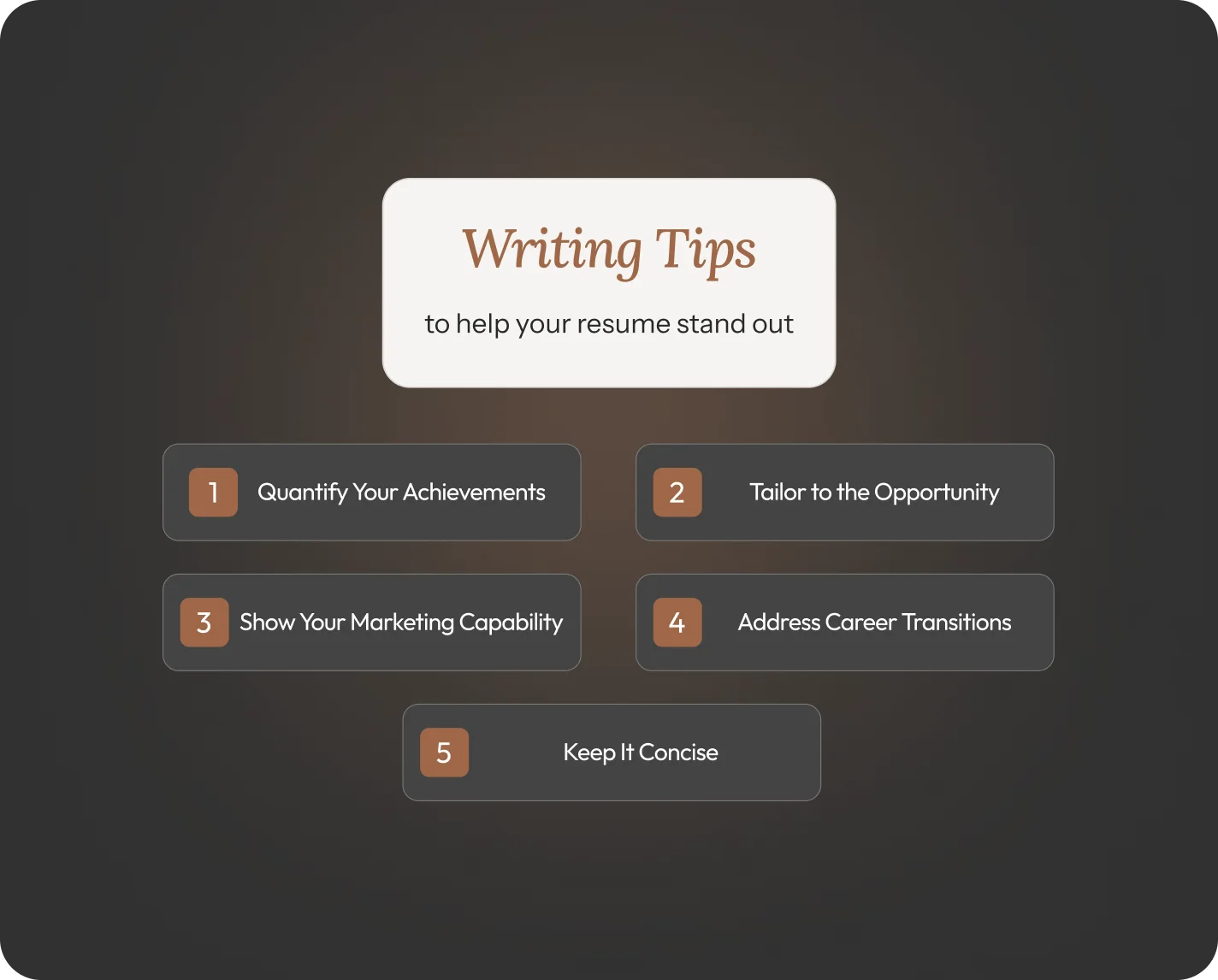
Quantify Your Achievements
•
Tailor to the Opportunity
•
Show Your Marketing Capability
•
Address Career Transitions
•
Keep It Concise
4. Common Resume Mistakes to Avoid
1. When You Need a Real Estate Agent Resume
Unlike many professions, real estate operates largely on an independent contractor model where agents build their own client base — which means a resume becomes a powerful tool in the specific moments it is needed.
However, several situations call for a polished resume:
Joining a new brokerage. Brokers evaluate your experience, production history, and professional background before extending offers — especially at selective firms.
Applying to join a team. Established teams receive applications from agents wanting to leverage their systems and lead flow. Your resume helps them assess fit.
Pursuing luxury or specialty positions. High-end brokerages and referral networks often require formal applications demonstrating relevant experience.
Transitioning from another career. New agents need to present transferable skills that predict success in real estate.
In each case, your resume serves as a professional summary that positions you for the opportunity you're pursuing.
2. What to Include in Your Real Estate Agent Resume
A strong real estate agent resume follows a clear structure while highlighting industry-specific achievements.
Contact Information
Include your name, phone number, email, city and state (full address isn't necessary), and links to your professional presence — your website, LinkedIn profile, or online portfolio.
For established agents, your personal website often matters more than the resume itself. It demonstrates how you present yourself professionally and market your services.
Professional Summary
Open with a brief paragraph (2-4 sentences) summarizing your experience, specialties, and key strengths. This isn't a generic objective statement — it's a snapshot of what you bring to the role.
Weak example: "A compelling summary goes beyond intent — it showcases your location, specialty, and measurable results to immediately demonstrate your value."
Strong example: "Licensed agent with five years of residential experience in the Seattle metro area. Specialize in first-time buyers and relocation clients. Closed $12M in transaction volume over the past 12 months."
The strong example includes specifics: location, specialty, and measurable results.
Licenses and Certifications
List your real estate license with the state and license number. Include relevant certifications such as:
- Certified Residential Specialist (CRS)
- Accredited Buyer's Representative (ABR)
- Seller Representative Specialist (SRS)
- Certified Luxury Home Marketing Specialist (CLHMS)
- Graduate, REALTOR Institute (GRI)
According to the National Association of Realtors, specialized certifications signal expertise and can differentiate you from other candidates — particularly for luxury or niche roles.


Work Experience
List your real estate positions in reverse chronological order. For each role, include:
- Company name and location
- Your title and dates employed
- 3-5 bullet points describing responsibilities and achievements
Focus on accomplishments rather than duties. "Closed 28 transactions totaling $8.5M in annual volume" demonstrates results in a way that makes your contribution immediately clear.
Use action verbs to start each bullet point: Negotiated, Managed, Generated, Represented, Coordinated, Marketed.
Production Numbers
Real estate is a numbers business. Include metrics that demonstrate your track record:
- Transaction volume (annual or career)
- Number of transactions closed
- Average days on market for listings
- List-to-sale price ratio
- Client retention or referral rate
If you're newer to the industry, focus on trajectory and improvement rather than absolute numbers.
Skills
Include both technical skills and soft skills relevant to real estate:
Technical skills: Contract negotiation, market analysis, CMA preparation, MLS proficiency, transaction coordination, listing marketing, lead generation
Soft skills: Client communication, relationship building, problem-solving, time management, negotiation
Tailor this section to the specific opportunity. A luxury brokerage values different skills than a high-volume residential team.
Education
Include degrees if relevant. In real estate, experience and production carry significant weight alongside formal education, so list your school, degree, and graduation year as part of a well-rounded picture.
Agents who have pursued real estate education, continuing education courses, and certifications can highlight that dedicated professional development prominently in this section.
3. Writing Tips for Your Real Estate Agent Resume
These strategies help your resume stand out from other applicants.
Quantify Your Achievements
Numbers catch attention and provide context. Compare these two descriptions.
Without numbers: "Successfully sold homes in the greater Phoenix area."
With numbers: "Closed 34 transactions totaling $11.2M in the greater Phoenix area, achieving 98% list-to-sale price ratio."
The second version gives the reader concrete evidence of your performance.



Tailor to the Opportunity
A resume customized for each application works far more effectively than a generic one. Research the brokerage or team you're applying to, understand their focus, and emphasize the experience most relevant to their needs.
Applying to a luxury firm? Highlight high-value transactions and luxury marketing experience. Joining a buyer-focused team? Emphasize buyer representation and client service skills.
Show Your Marketing Capability
Modern real estate success depends heavily on marketing skills. Brokerages and teams want agents who can generate business and represent listings professionally.
Include marketing-related accomplishments: social media presence, listing marketing approaches, video content, lead generation campaigns. If you use tools like Trolto to maintain professional listing videos and branded content, that demonstrates you invest in marketing infrastructure — something brokerages value in recruits.
Address Career Transitions
If you're entering real estate from another field, connect your previous experience to real estate skills. Sales experience translates to client acquisition. Customer service roles demonstrate relationship management. Marketing backgrounds show promotional capability.
Frame your transition as an asset: you bring outside perspectives and established professional skills to a new industry.
Keep It Concise
One page is ideal for most agents with under ten years of experience. Two pages maximum for veterans with extensive credentials and production history.
Cut anything that doesn't strengthen your candidacy. Old, unrelated jobs from early in your career can be summarized or omitted entirely.
4. Common Resume Mistakes to Avoid
Generic objective statements. "Seeking a challenging position in real estate" adds nothing. Replace with a specific professional summary.
Listing duties without results. Strong agents show homes and write contracts—now highlight the exceptional results and achievements that set your experience apart.
Including irrelevant information. A professional resume can be strengthened by focusing on experience most relevant to the role, though early jobs and hobbies may be worth including when they directly support your candidacy.
Typos and formatting errors. Attention to detail matters in real estate. Proofread carefully, and ask someone else to review before submitting.
Outdated contact information. Verify your phone number and email are current and professional. A professional email address helps establish credibility and makes a strong first impression with clients.
FAQ
Do I need a resume if I'm an independent contractor?
Technically no — you're not applying for employment in the traditional sense. However, brokerages still evaluate agents before affiliating with them, and a professional resume helps you present your background effectively. It's also useful for referral network applications and team opportunities.
How do I write a resume with limited real estate experience?
Focus on transferable skills from previous careers, any real estate training or education you've completed, and your business plan for building your practice. Emphasize qualities that predict success: sales aptitude, self-motivation, communication skills, local market knowledge.
Should I include production numbers if they're not impressive?
If your numbers are low relative to competition, focus on other strengths: client satisfaction, specialty knowledge, marketing skills, professional development. You can also highlight trajectory — showing improvement year over year — rather than absolute numbers.
Present Yourself Professionally
Your real estate agent resume is one piece of your professional presentation. It works alongside your online presence, marketing materials, and reputation in the market.
The agents who stand out present themselves consistently across every touchpoint — from their resume to their website to their listing marketing. If you want to ensure your visual marketing matches the professionalism of your resume, Trolto can help with cinematic listing videos, property websites, and daily branded content that positions you as a serious professional.
See how Trolto works