.webp)
Marketing
12 Real Estate Open House Ideas That Generate Leads
Most real estate open house ideas you'll find focus on snacks and signage. Those basics matter, but they don't differentiate you. Every agent offers cookies and bottled water. The question is: what makes visitors remember you — and more importantly, what makes them reach out afterward?
The agents generating consistent leads from open houses treat them as marketing events, not property showings. They think about the experience before, during, and after. They capture contact information systematically. And they follow up in ways that add value rather than annoy.
This guide covers the open house strategies that move the needle — from pre-event promotion to post-event follow-up.

February 10, 2026

7 min read
Share


What We'll Explore
1. Why Open Houses Still Matter
2. Pre-Event: Real Estate Open House Ideas for Promotion
•
Promote Beyond the MLS
•
Create Shareable Content Before the Event
•
Give Visitors a Destination
3. During the Event: Ideas That Capture Leads
•
Make Sign-In Effortless (and Required)
•
Create Conversation Starters
•
Partner With Complementary Professionals
•
Add Small Touches That Stand Out
4. Post-Event: Follow-Up That Converts
•
Follow Up Fast
•
Provide Ongoing Value
•
Share Marketing Results With Your Seller
1. Why Open Houses Still Matter
The goal isn't to sell the house you're sitting. Research from Zillow's Consumer Housing Trends Report shows that buyers attend an average of three open houses during their search — meaning they're actively evaluating multiple properties and agents simultaneously.
But that statistic reveals the opportunity.
Open houses are lead generation events. The buyers walking through your open house are actively shopping — they might not buy this particular home. Your job is to capture their information, understand their needs, and become the agent they work with when they find the right property.
Sellers benefit too. They see you actively marketing their home. Neighbors attend and spread word-of-mouth. And even if the open house doesn't produce a direct buyer, the activity signals market interest.
2. Pre-Event: Real Estate Open House Ideas for Promotion
Proactive promotion is what drives attendance and, in turn, generates leads. Promotion determines attendance, and attendance determines leads.
Promote Beyond the MLS
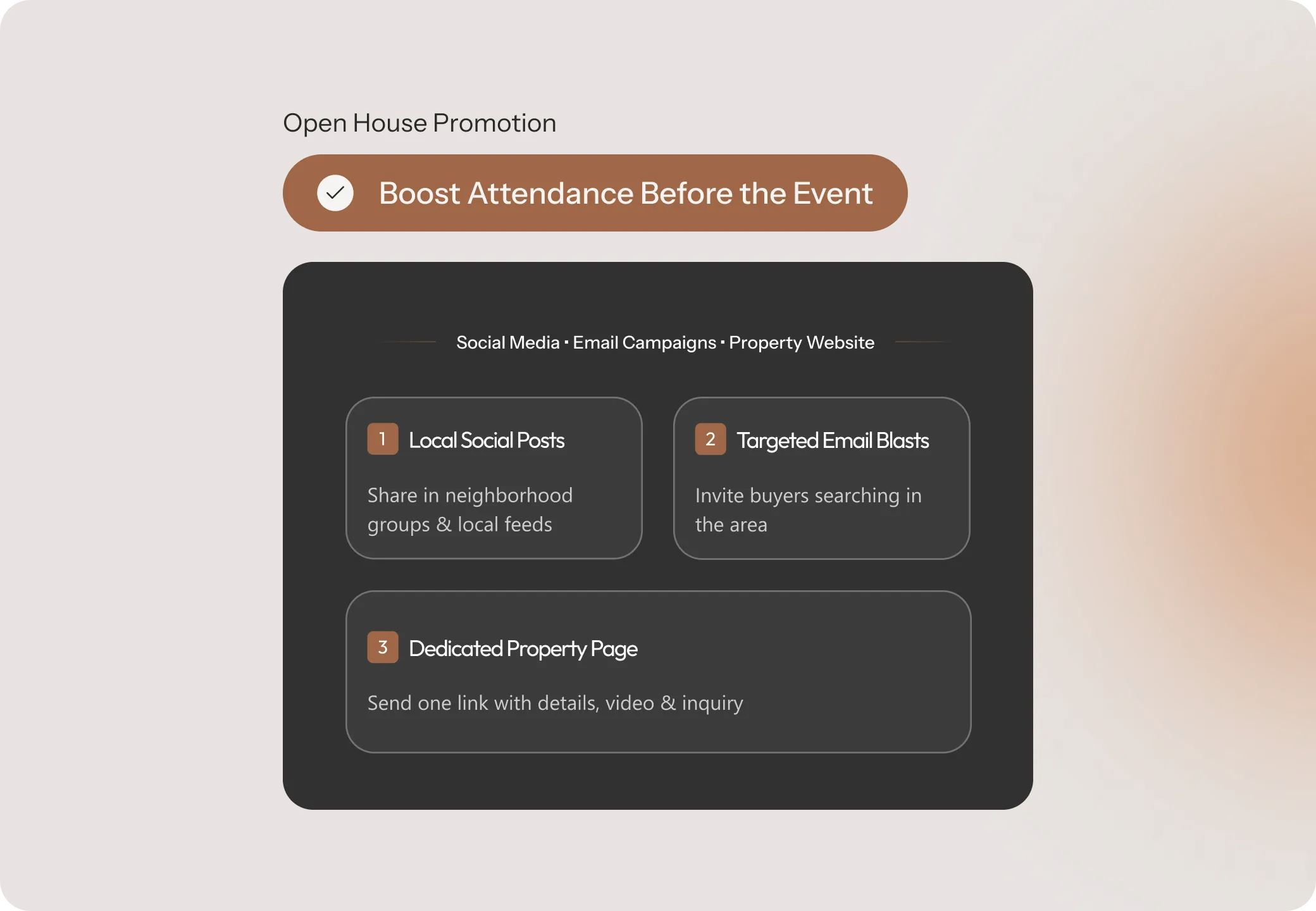
Listing your open house on the MLS is baseline. To maximize attendance, you need to promote across multiple channels in the days leading up to the event.
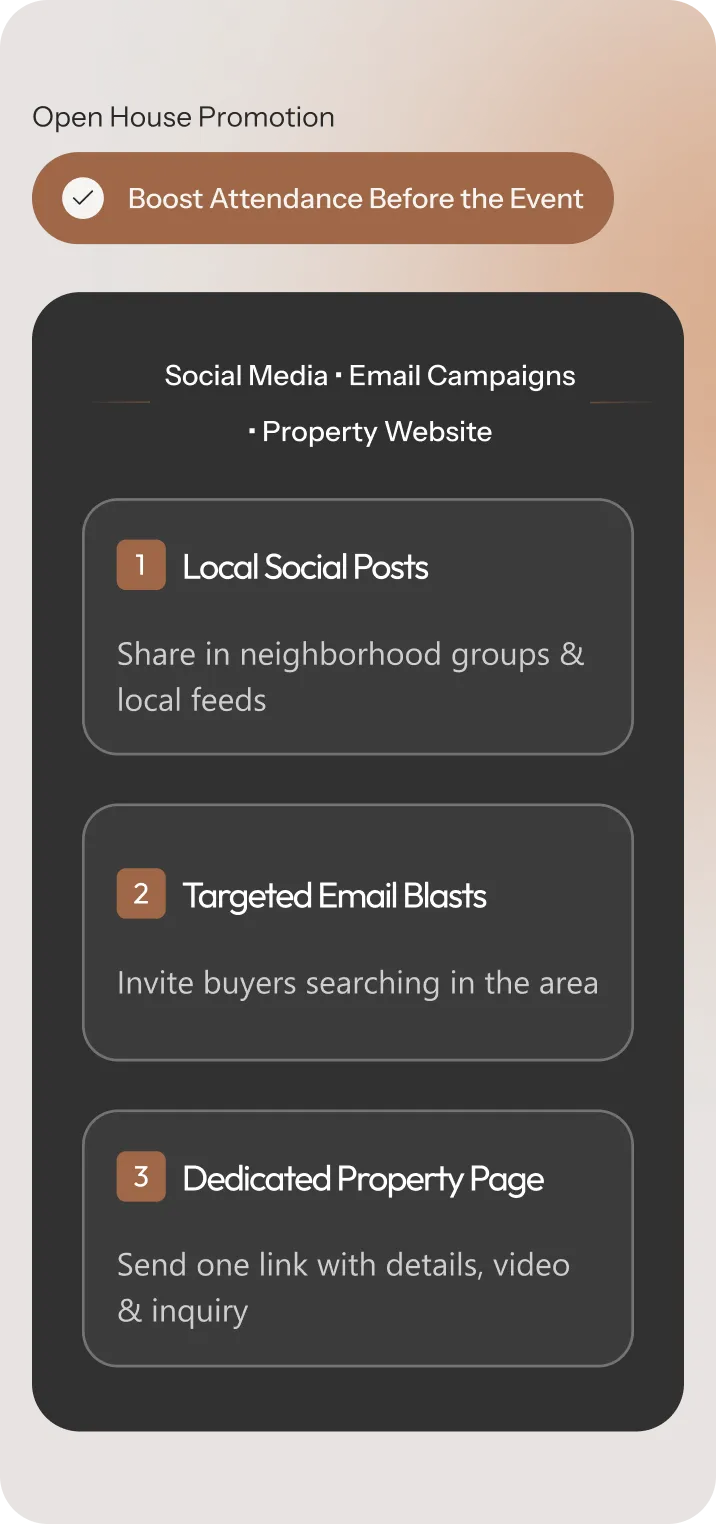
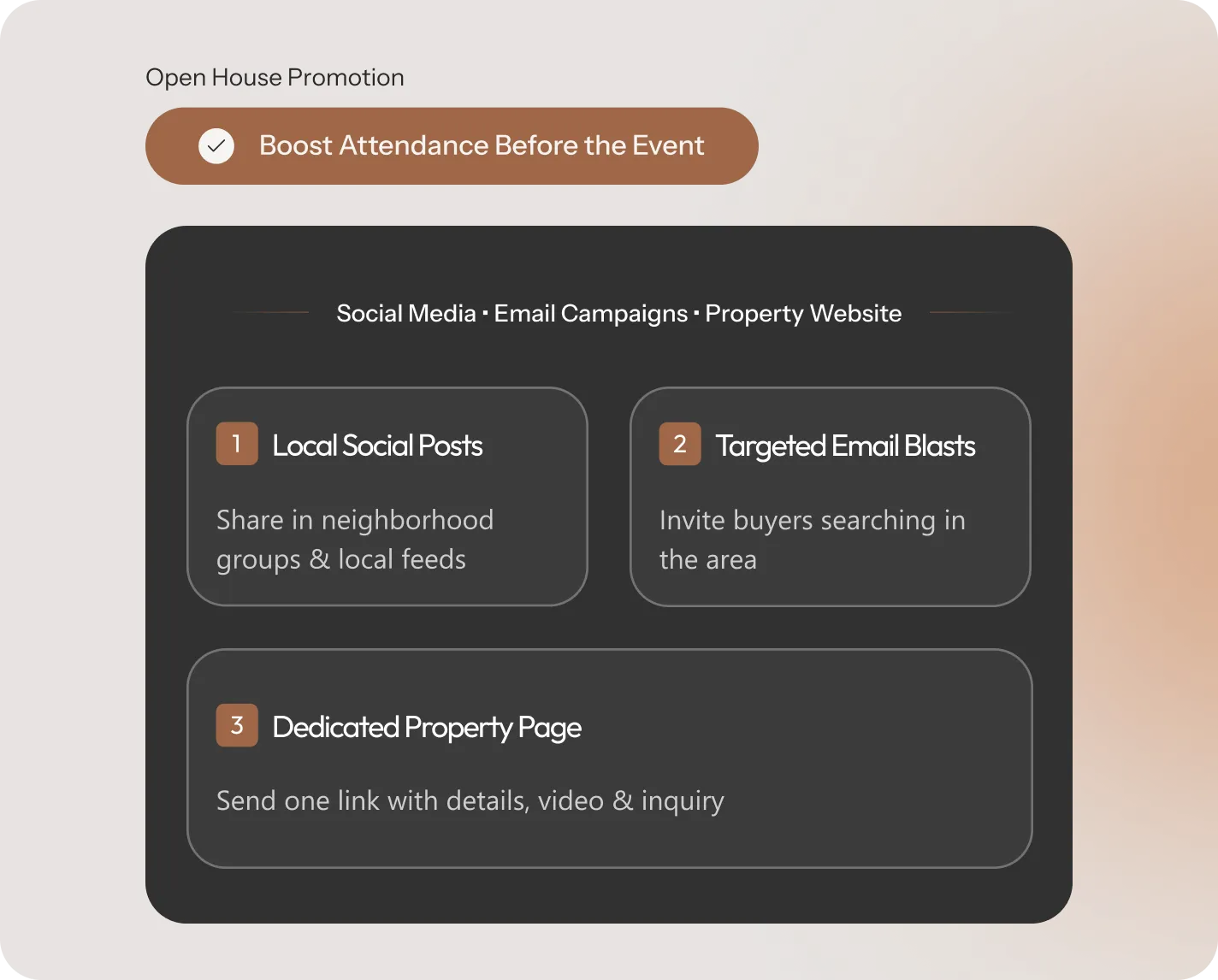
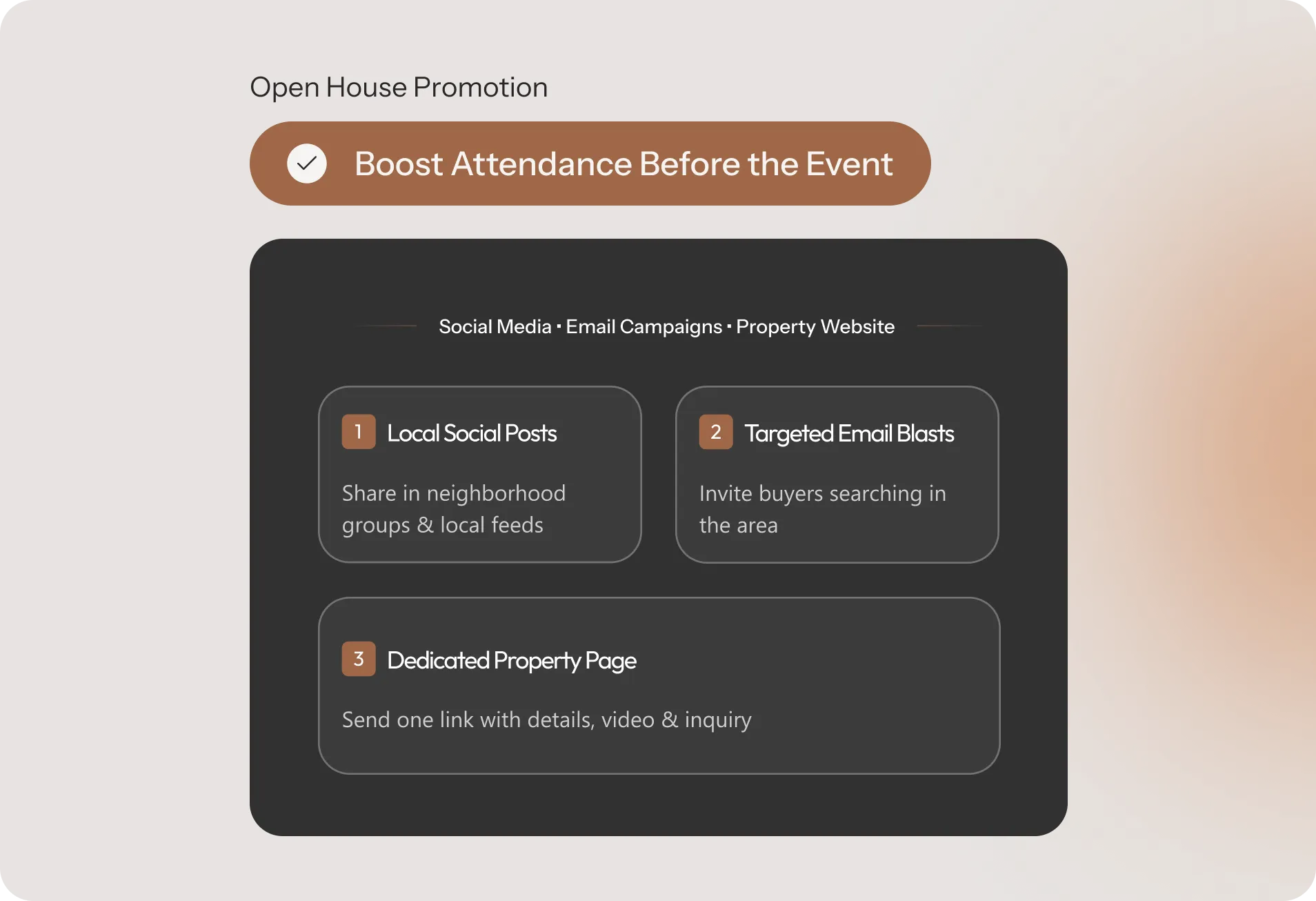
Post on local Facebook groups and Nextdoor. These hyperlocal platforms reach people who live nearby — unlike paid social ads that might target users hundreds of miles away. Neighbors attend open houses, and neighbors talk. They also become future listing leads when they see you actively working their area.
Send email blasts to your database. Segment by location and buyer status so you're reaching people who might attend. A dedicated "Open House This Weekend" email to buyers searching in that area will outperform a generic newsletter mention.
Door knock the surrounding streets. It feels old-school, but direct invitations work. Neighbors are curious about pricing and condition. Some have friends or family looking to move nearby. And every conversation builds your reputation as the active agent in that neighborhood.
Create Shareable Content Before the Event
Give people a reason to share your open house beyond the basic "Come visit!" announcement.
Short video walkthroughs posted to Instagram Reels, TikTok, and YouTube Shorts generate significantly more engagement than static photos. A 30-second clip highlighting a unique feature — the kitchen, the backyard, the view — can reach buyers who would never see your MLS listing.
If creating video content for every open house feels unsustainable, tools like Trolto can help. Upload your listing photos and get a cinematic property video back in minutes, formatted for every platform. That video becomes your promotional asset across social media, email, and even the property website visitors can explore before they arrive.
Give Visitors a Destination
Instead of promoting an address, promote a property website where interested buyers can learn more before (and after) the event.
A dedicated listing page — separate from Zillow or Realtor.com — gives visitors detailed information, video content, and a way to inquire directly with you. It also captures visitors who can't attend in person but want to stay informed.
Trolto generates these single-property websites automatically from your listing photos, complete with your branding and built-in lead capture. Include the link on all your promotional materials, signage, and QR codes at the open house itself.
3. During the Event: Ideas That Capture Leads
Once visitors arrive, your focus shifts to creating a memorable experience and systematically capturing contact information.
Make Sign-In Effortless (and Required)
Every visitor should sign in. No exceptions. But the sign-in process matters.
Digital sign-in using a tablet or QR code feels more professional than a paper clipboard. It also captures information more accurately — no illegible handwriting or fake phone numbers. Apps like Curb Hero let visitors scan a code and enter their details on their own phone, reducing friction.
Position sign-in strategically. Placing it at the door works, but placing it near refreshments can feel more natural. People signing in while grabbing a drink feels less transactional.
Be upfront about why you're collecting information. "I'll send you details on similar homes as they hit the market" is a value proposition. "I'll keep you updated on similar homes" gives visitors a clear reason to share their details.
Create Conversation Starters
The most effective open house agents answer questions and initiate meaningful conversations that reveal buyer needs.
Prepare a few open-ended questions: "What brings you out today?" "How long have you been looking?" "What's most important to you in your next home?" These questions provide context for follow-up and help you match visitors with appropriate listings.
Have neighborhood information readily available. School district details, walkability scores, nearby amenities, recent sales data. Buyers appreciate agents who know the area, not the house alone.
Partner With Complementary Professionals
A lender on-site can answer financing questions that you can't (and shouldn't) address. Buyers often have mortgage confusion — rates, down payment requirements, approval timelines. A trusted lending partner adds value for visitors and strengthens your referral relationship.
For luxury properties, consider additional partners: interior designers who can discuss renovation potential, architects who can speak to structural possibilities, or local business owners who can speak to the neighborhood lifestyle.
Add Small Touches That Stand Out
Hospitality matters, but thoughtfulness matters more than expense.
Quality over quantity with refreshments. A curated selection from a local bakery beats generic grocery store cookies. Branded water bottles with your contact information serve a purpose without feeling pushy.
For families, a small activity area for kids lets parents focus on the property. Coloring books, a few toys, maybe a tablet with a kid-friendly app. Parents remember the agent who made their visit easier.
Branded takeaways that people keep — useful items like dish towels, phone chargers, or reusable bags — stay in their homes longer than business cards that get tossed.
4. Post-Event: Follow-Up That Converts
The open house itself is the beginning. What happens in the 48 hours after determines whether visitors become clients.
Follow Up Fast
Speed matters. Follow up within 24 hours while the property — and you — are still fresh in their minds.
Personalize based on your conversation. "Great meeting you at the open house today. You mentioned looking for a larger backyard for your kids — I wanted to share a few listings that might fit." This kind of message demonstrates that you listened and positions you as a resource, not a salesperson.
For visitors you didn't speak with directly, a general follow-up still works: "Thanks for stopping by [address] yesterday. I'd love to hear your thoughts and help if you're still searching."
Provide Ongoing Value
One follow-up isn't enough. The average buyer takes months to purchase. Stay in touch without being annoying by providing value.
Send new listings that match their criteria. Share market updates relevant to their target neighborhoods. Offer to set them up on an automated search if they're interested.
Your goal is to be the agent they think of when they're ready — not the one who pestered them with "checking in" emails.
Share Marketing Results With Your Seller
After every open house, report back to your seller with concrete data: number of visitors, feedback received, follow-up conversations scheduled.
If you're using a property website with analytics — like the ones Trolto generates — you can show traffic numbers, time on page, and inquiry volume. This demonstrates proactive marketing and builds seller confidence, especially if the home doesn't sell immediately.
FAQ
How many visitors should I expect at an open house?
Attendance varies significantly by market, property type, and promotional effort. In active markets, 10-30 visitors over a 2-3 hour window is typical for well-promoted open houses. Luxury properties often see fewer but more qualified visitors. Focus less on raw attendance and more on quality conversations and captured contact information.
What's the best day and time for an open house?
Sunday afternoons (1-4 PM) remain the most popular, though Saturday can work well depending on your market. Avoid competing with major local events or holiday weekends. For luxury properties, by-appointment showings or weekday evening events sometimes work better than traditional weekend hours.
How do I get more people to attend my open houses?
Promotion is everything. Start promoting 5-7 days in advance. Use multiple channels: MLS, social media (especially video content), email to your database, door knocking nearby streets, and hyperlocal platforms like Nextdoor. Give visitors a reason to attend beyond curiosity — whether that's the property itself, a neighborhood focus, or something unique about the experience.
Make Every Open House Count
The best real estate open house ideas share a common thread: they treat the event as a lead generation opportunity, not a property showing. From strategic promotion to meaningful conversations to systematic follow-up, every element should serve the goal of building relationships with future clients.
Your open house marketing shouldn't stop when the event ends. A property website, video content, and ongoing social presence keep the listing visible and position you as the professional choice. If building these assets for every listing feels overwhelming, tools like Trolto can systematize the process — generating cinematic videos, property websites, and branded content automatically so you can focus on the conversations that convert visitors into clients.
See how Trolto works